If you have ever looked at an Axminster carpet specification and seen terms such as repeat across, repeat down, set match or half drop, you may have wondered what they actually mean.
Pattern repeats can sound complicated, but the basic principle is quite simple. A carpet design repeats at measured intervals across the width and down the length of the carpet. How those repeats line up when adjoining widths of carpet are installed is known as the pattern match.
Understanding these measurements is useful for interior designers, specifiers and installers because pattern repeats can influence the appearance of the finished floor, how adjoining widths are positioned and the amount of carpet required for a project.
Here, we break it down using real Axminster carpet designs from our stocked range.
What Is Broadloom Carpet?
Before looking at pattern repeats, it helps to understand the carpet itself.
Axminster carpet is typically manufactured as broadloom carpet at a standard width of 3.66 metres (366 cm). The 3.66 metre width originates from the 12-foot broadloom measurement.
Carpet manufacturing equipment was historically produced using imperial dimensions, with 12-foot broadloom becoming increasingly common and, by the latter part of the 20th century, an established standard width.
As the carpet industry transitioned to metric measurements, the established width remained. Twelve feet is approximately 3.66 metres, which explains why this seemingly unusual measurement is still commonly used in carpet manufacturing today.
While 3.66 metres remains Hotel Carpet’s standard Axminster width, 4 metre wide Axminster can also be custom manufactured for projects where a wider carpet is required.
The carpet width is important when it comes to pattern repeats, because Axminster patterns are designed to work within the dimensions of the broadloom width.
What Is a Carpet Pattern Repeat?
A pattern repeat is the point at which a design begins to repeat itself.
There are two measurements to consider:
Repeat Across tells you how often the design repeats across the width of the carpet.
Repeat Down tells you how often the design repeats along the length of the carpet.
These measurements don’t have to be the same.
For example, a design could repeat every 366 cm across the carpet but every 600 cm down its length. This creates a much larger-scale pattern in one direction than the other.
How Does the 366 cm Carpet Width Affect the Pattern?
Because our Axminster broadloom is 366 cm wide, pattern repeats across the width are typically designed to divide evenly into 366 cm.
Some common repeat widths are:
| Repeat Across | Number of Repeats Across 366 cm |
| 366 cm | 1 |
| 183 cm | 2 |
| 122 cm | 3 |
| 91.5 cm | 4 |
This means that if a design has a 183 cm repeat across, for example, the pattern repeats twice within one 366 cm width of carpet.
The repeat size is selected according to the design. A large-scale organic design may benefit from a larger repeat, while a smaller geometric pattern may repeat more frequently.
Importantly, repeat across should not be confused with repeat down. Repeat down is determined by the design and can be a completely different measurement.
Understanding Pattern Matches
This is where terms such as set match and half drop come in.
The pattern repeat describes the dimensions of the repeating design.
The pattern match describes how that design lines up when adjoining widths of carpet are placed next to one another.
Two of the most common arrangements you’ll encounter with Axminster are set match and half drop.
What Is a Set Match?
A set match means that the pattern on the adjoining carpet width lines up at the same point.
Think of two identical sheets of patterned wrapping paper placed beside one another. If you position them so that the same part of the pattern starts at the same height on both sheets, you have essentially created a set match.
Example: Daintree
Match: Set Match
Repeat Across: 183 cm
Repeat Down: 183 cm
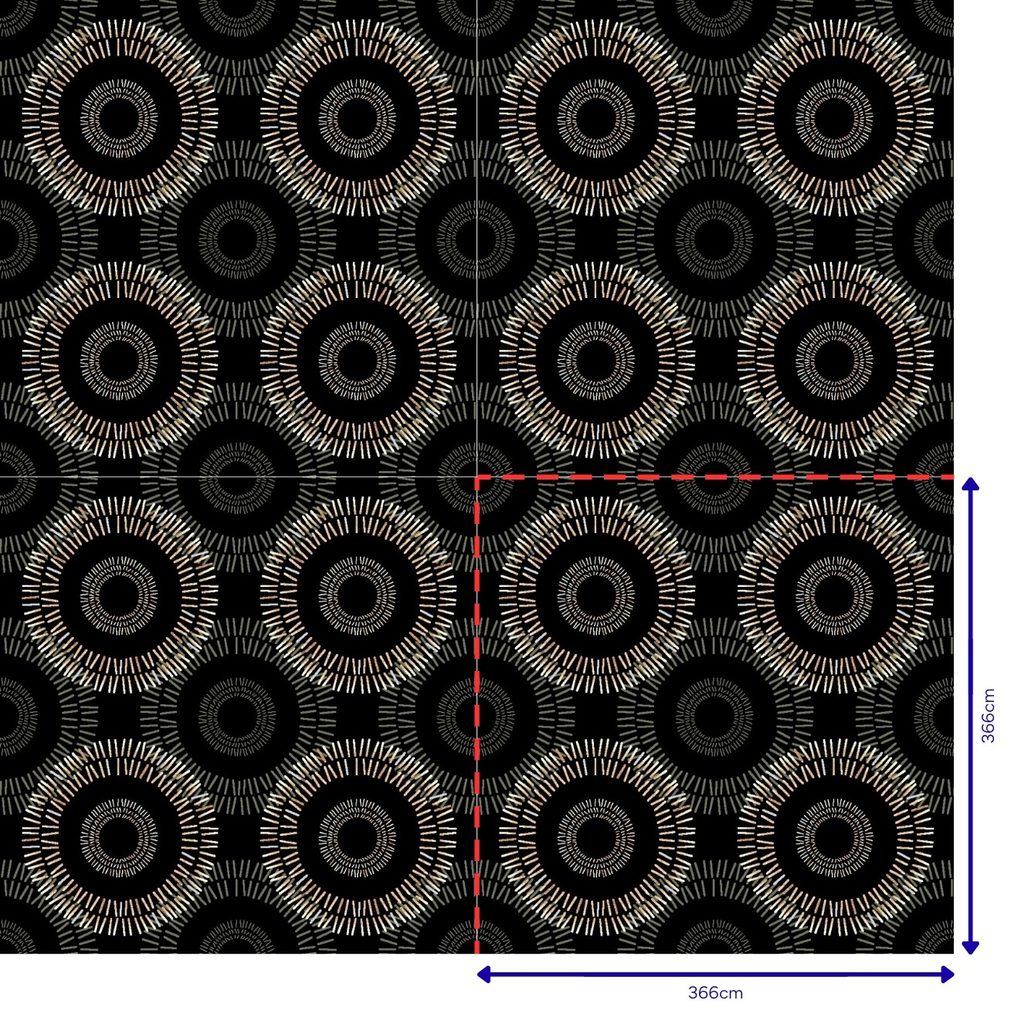
Daintree has a repeat across of 183 cm, so the design repeats twice within the full 366 cm broadloom width.
It has a repeat down of 183 cm, meaning the pattern begins repeating again every 183 cm down the length of the carpet.
When adjoining widths are installed, the pattern is positioned at the same point so the design continues consistently from one width to the next.
What Is a Half Drop?
A half drop match works differently.
Rather than positioning the adjoining width at exactly the same point in the pattern, the pattern is offset.
This can help create a more continuous visual flow and make the repetition of a design less obvious, particularly with larger or more organic patterns.
Example: Andesite
Match: Half Drop
Repeat Across: 366 cm
Repeat Down: 366 cm
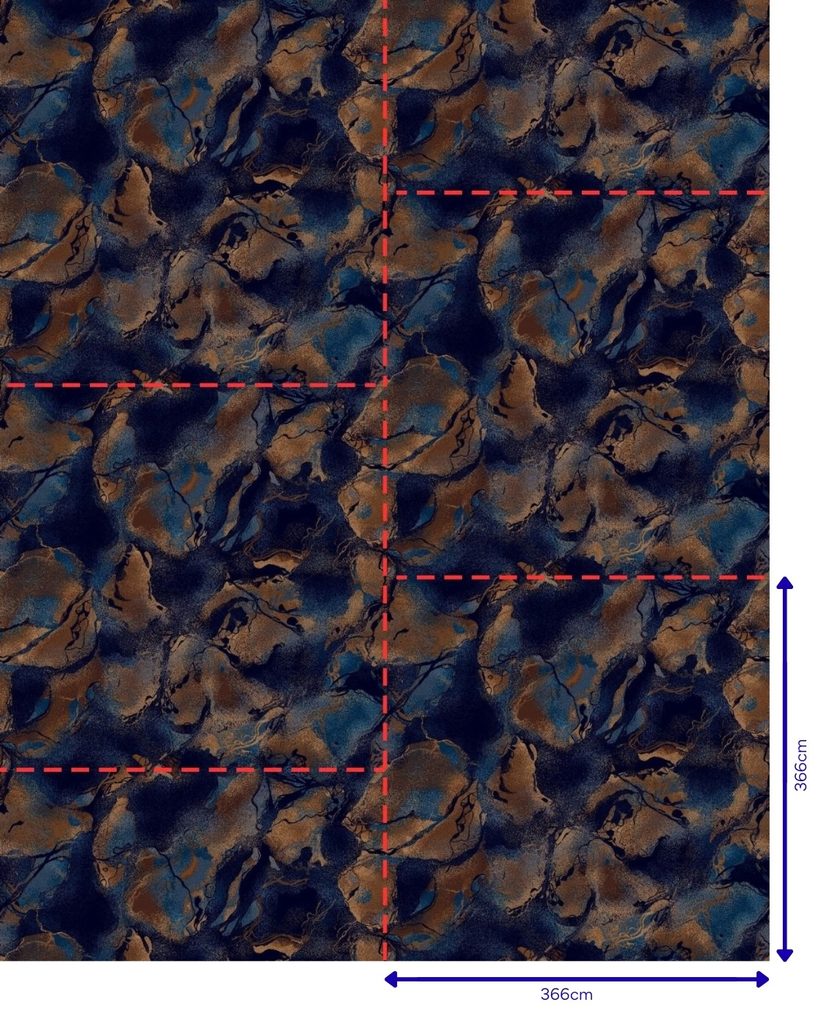
Andesite has a full-width 366 cm repeat across and a 366 cm repeat down.
However, when adjoining carpet widths are matched, the design uses a half drop. Rather than identical elements sitting directly beside one another, the adjoining pattern is offset down the length of the carpet by half of the repeat down measurement.
For Andesite, the repeat down is 366 cm, so each adjoining width is offset by 183 cm (half of 366 cm).
Look at the red dashed boxes in the Andesite diagram and you’ll see that they aren’t sitting side by side at the same height. One is shifted relative to the other.
That’s the basic principle of a half drop.
It allows a large pattern such as Andesite to flow across a floor without creating an obvious grid of identical motifs.
A Pattern Can Have More Than One Matching Option
Now we get to a slightly more interesting example.
A carpet specification isn’t always simply “set match” or “half drop”.
Depending on the repeat structure, a design can have relationships at different points across the full broadloom width.
Example: River
Match: Half Drop at 183 cm; Set Match on 366 cm
Repeat Across: 183 cm
Repeat Down: 605 cm
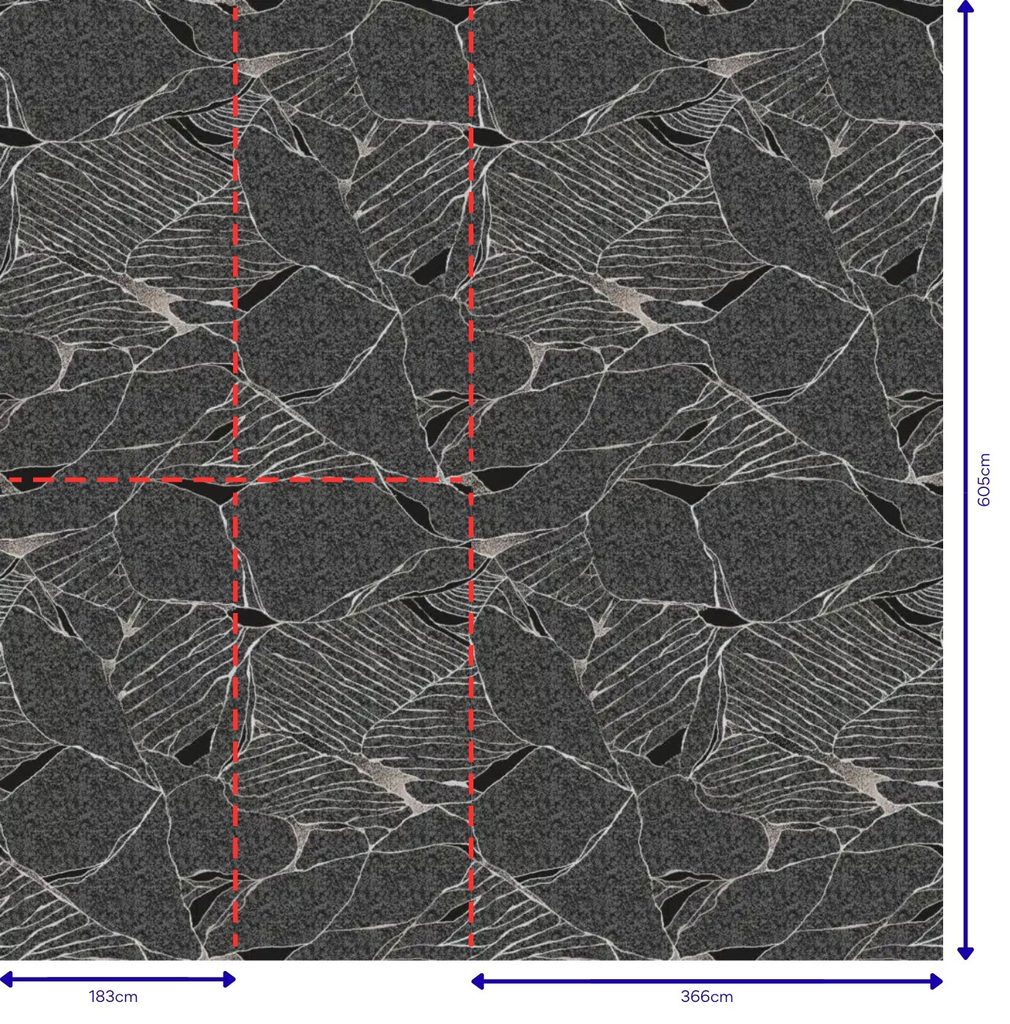
River has a 183 cm repeat across, meaning the pattern repeats twice across the full 366 cm broadloom width:
183 cm + 183 cm = 366 cm
It has a 605 cm repeat down. The second 183 cm-wide repeat is offset by half of this vertical repeat, or 302.5 cm (half of 605 cm), creating the half-drop arrangement.
At the full 366 cm broadloom width, the pattern returns to the same position, creating a set match.
This is why River can be described as having a half drop at the 183 cm repeat and a set match at 366 cm.
River is a good demonstration of why all three pieces of information matter. Simply knowing the repeat across doesn’t tell you everything about how the carpet will be positioned and matched. You also need to know the repeat down and pattern match.
Why Do Pattern Repeats Matter?
Pattern repeats aren’t just information for the person designing the carpet. They become particularly important when calculating and installing patterned broadloom carpet.
1. They determine how the finished pattern flows
A well-planned repeat allows the design to continue across adjoining carpet widths without visually disruptive breaks.
This becomes especially important with large-scale patterns in spaces such as hotel bistros, gaming rooms, clubs, restaurants and function spaces.
2. They affect carpet quantities
Patterned carpet generally requires consideration beyond simply calculating the square metres of the room.
Additional carpet may be required to correctly position and match the pattern between adjoining widths. The amount required will depend on the repeat, match, room dimensions and installation layout.
This is why two rooms with exactly the same floor area may not necessarily require exactly the same quantity of patterned carpet.
3. They affect installation planning
An installer needs to know where the pattern repeats so adjoining widths can be positioned correctly.
This is particularly important with large repeats. A pattern with a 605 cm repeat down, for example, needs to be approached differently from one repeating every 100 or 150 cm.
Understanding the manufacturer’s pattern information before cutting and positioning the carpet helps ensure the design flows as intended across the finished floor.
4. Repeat size affects the look of the design
Repeat size is also an important design consideration.
Smaller repeats tend to make repetition more frequent, while larger repeats give the design more room to develop before it begins again.
For custom Axminster carpet, this gives designers considerable freedom to work with the scale of a space. A large hospitality floor, for example, can accommodate expansive patterns that might overwhelm a much smaller room.
How does pattern matching affect carpet wastage?
Pattern matching can increase the amount of carpet required for an installation. When adjoining widths need to be moved forward or back to align the pattern correctly, some carpet may need to be trimmed away.
The amount of additional carpet required depends on the repeat down, the type of pattern match, the room dimensions and the installation layout. Generally, larger pattern repeats have the potential to create more wastage, particularly across multiple adjoining widths.
A well-planned installation can help minimise this. Accurate measurements and planning the position of each carpet width before cutting allows the installer to achieve the correct pattern match while reducing unnecessary waste.
Pattern Repeats Don’t Have to Be Complicated
Terms such as 366 cm repeat, 183 cm half drop and 605 cm repeat down can look highly technical at first, but they are simply measurements describing how a pattern repeats and how adjoining carpet widths relate to one another.
For Hotel Carpet’s 3.66 metre Axminster carpet, repeats across the width are typically designed to divide evenly into the full 366 cm width, commonly at 366 cm, 183 cm, 122 cm or 91.5 cm.
From there, the repeat down determines how frequently the design repeats along the roll, while the match tells the installer how adjoining widths should relate.
Understanding these fundamentals makes it easier to design, specify, estimate and install patterned Axminster carpet, and ultimately helps ensure the pattern looks the way it was intended once it reaches the floor.